THE DESIGN TRIAD
A designer is anyone who negotiates between Reality, Utility, and Intent.
Design often feels like an unconscious process aimed at generating an end product. From beginning to end, designers deal with perception, intuition, interpretation, formulation, testing, refining, and resolution, all bespoke to each project they undertake. Many never think they follow a workflow, or at least not consciously, until they pause to reflect and realise they have developed their own pattern.
Over years of practice, from complex infrastructure projects to small objects like furniture, a recurring pattern emerges. Every project is shaped by a mix of three core drivers: the Where, the What, and the Who.
The Three Drivers
Context: The Reality
This is the "Where" and the "When." It includes the physical location, the climate, the historical background, and the cultural surroundings. Context ensures the design belongs to its environment rather than being an alien object dropped into a space.
Context changes whether the project is an architectural structure, a piece of furniture, or any other creation. It encompasses not only the physical environment (location, climate, spatial constraints) but also cultural, historical, and social influences that shape the designer's choices.
Purpose: The Utility
This is the "What" and the "How." It is the functional reason the object exists. It focuses on the user's needs, safety, ergonomics, and efficiency. If a design has no purpose, it is a failure of engineering. It must work.
Purpose defines what the design must accomplish: how something will be used and how it functions, shaped by the needs of its users and the demands of its environment.
Vision: The Intent
This is the "Who", the human element. It is the designer's personal interpretation, creative signature, and deliberate design intent. Vision provides character, the "wow" factor, and unique identity.
Vision is influenced by the designer's attitude and interpretation, and it is what generates vastly different outcomes from the same starting point. Consider a design competition: same context, same purpose, yet as many different designs as there are contestants.
The Triangle

The Design Triad triangle
These three drivers form a triangle, the Triangle of Drivers. Every design project sits somewhere within it.
Design is not a static formula; it is a shifting dot inside the triangle.
Warehouse: The dot is pulled toward the Purpose corner. Function is everything; Vision is secondary.
Luxury Residential: The dot moves toward Vision. The client is paying for the designer's unique signature and a specific lifestyle.
Artistic Installation: The dot sits almost entirely in Vision, with very little Purpose beyond existing for beauty or thought.

Triangle with dot positions for different project types
The dot positions above reflect an architectural perspective. Other disciplines would place them differently. A civil engineer designing an airport, for example, would likely pull the dot much closer to Context, where site conditions, ground engineering, and environmental constraints dominate. A branding consultant working on the same airport might shift the dot toward Vision. This is precisely the point: each discipline must define the triad for itself.
A Universal Framework
The framework is universal, the interpretation is personal. The beauty of Context, Purpose, and Vision is that they describe the fundamental nature of human creation. To apply them to any discipline, one simply adapts the definitions.
| Industry | Context | Purpose | Vision |
|---|---|---|---|
| Architecture | Site, Climate, Zoning | Shelter, Circulation | Style, Atmosphere |
| Graphic Design | Brand history, Screen size | Readability, CTA | Visual Metaphor |
| Software/UX | User device, Privacy | Task speed, Efficiency | Brand Personality |
| Fashion | Season, Fabric availability | Comfort, Durability | Silhouette, Identity |
| Engineering | Space, Temperature | Load capacity, Torque | Elegant Routing |
The secondary factors can also be folded into the three primary drivers:
Context absorbs: Budget, Regulations, Site, Climate, History, Site constraints, and Materials.
Purpose absorbs: User Needs, Ergonomics, Safety, and Technical Function.
Vision absorbs: Aesthetics, Branding, Personal Style, and Innovation.
The Circle of Constraints
Surrounding the triangle is the Circle of Constraints, a boundary that represents the hard limits of the real world: Time, Law, Politics and Physics. These are the factors that a designer cannot freely interpret, but they are important as they often define the designer's playground.
This circle can squeeze or expand.
The Squeeze: If the deadline is tight, regulations are strict, or political pressures are heavy, the circle shrinks, compressing the triangle and giving the designer less room to move.
The Expand: If time is generous, regulations are flexible, and there is political support, the circle grows, allowing the designer to push Vision or Context to extreme, innovative lengths.
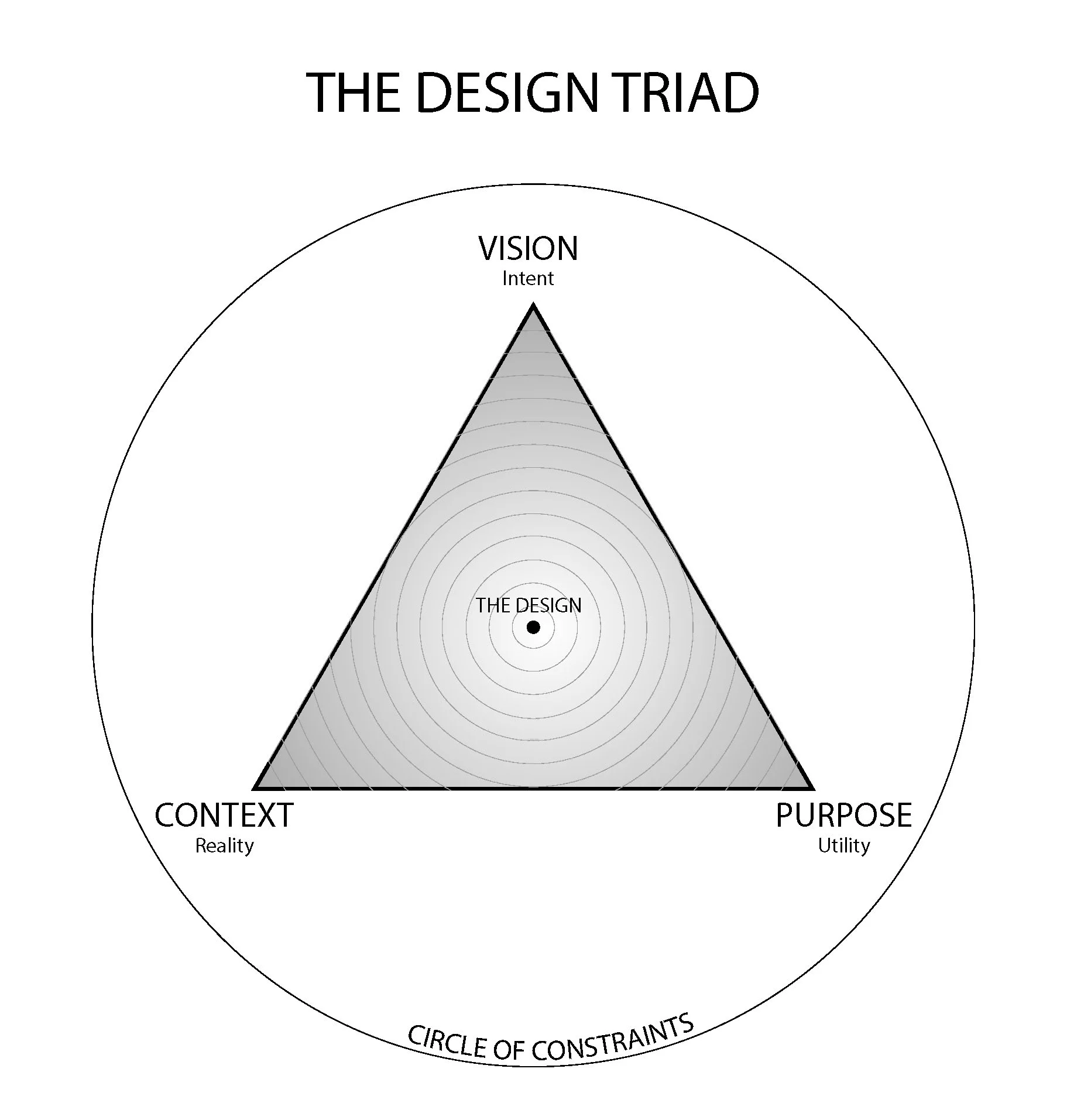
Triangle inside the Circle of Constraints
How to Use the Design Triad
The triad is not just a theoretical model; it is a practical tool. One application is project selection. A practice can define its target zone within the triangle, the area where its expertise, values, and market positioning sit. Any incoming project can then be plotted as a dot. If the dot falls inside the target zone, it is a Go. If it falls outside, it is a No Go.
The diagram below shows a practice whose target zone sits toward Vision. Projects 2 and 3 fall within it and proceed. Projects 1 and 4 fall outside and are declined. A different practice, one specialised in industrial manufacturing for example, would draw its target zone toward Context and Purpose, and the same projects would receive opposite decisions. The triad becomes a filter for strategic alignment.
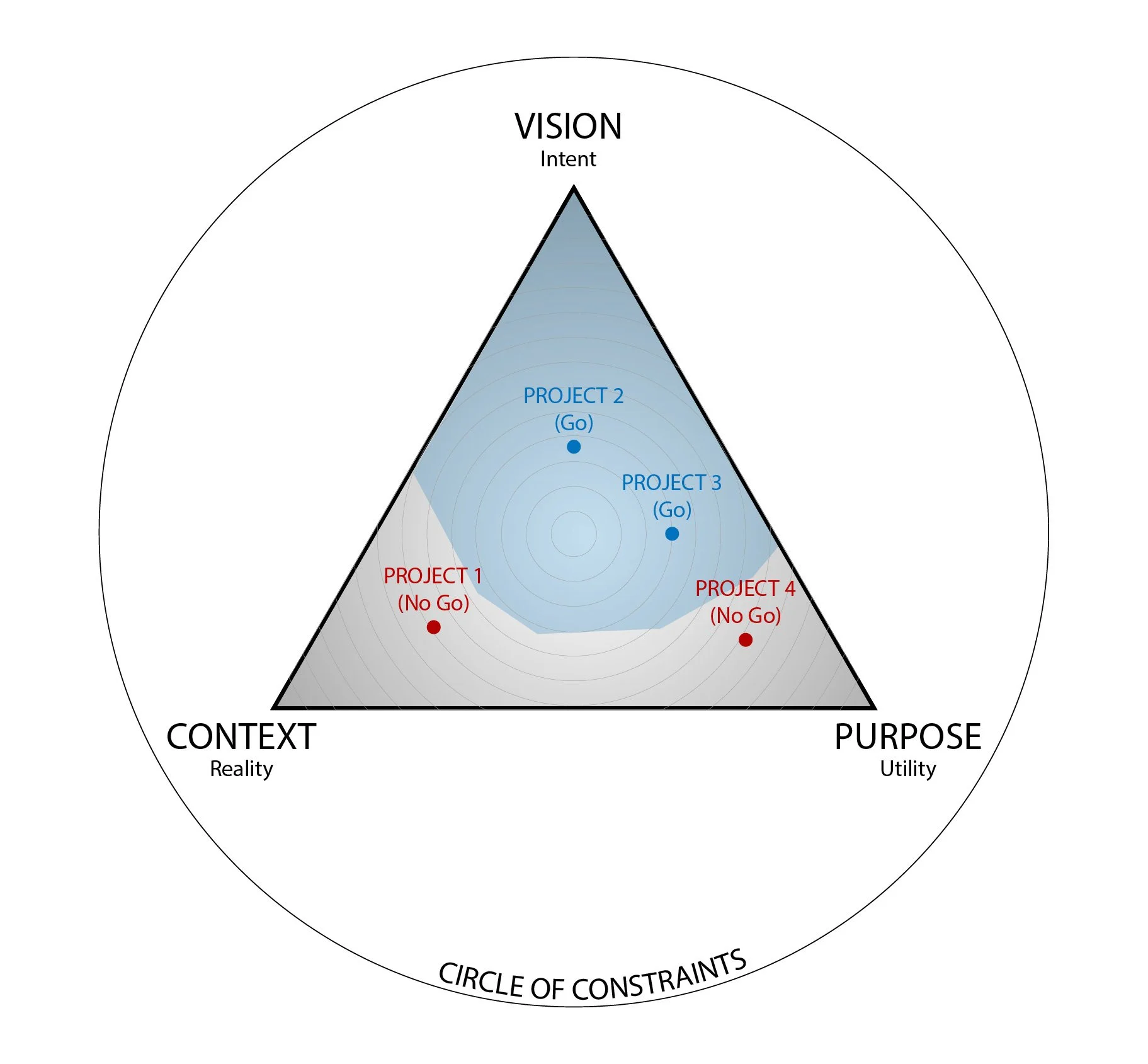
The Design Triad - Go/No Go diagram
This example is architectural, but every discipline can do the same exercise. Even the client should plot their own dot. When the dots from the architect, the engineer, and the client are placed on the same triangle, it becomes immediately clear whether the team is aligned or pulling in different directions.
Why It Matters
This framework demonstrates that every professional, whether an architect, an electrical engineer, or a painter, is a designer. They all sit inside the same triangle; they simply have their dots in different corners. Design is not about finding a perfect balance between these three pillars. It is a constant negotiation. The key is that the designer, the engineer, and the client all agree on where the dot should sit, and how to make that dot shine, regardless of the size of the Circle of Constraints.